|
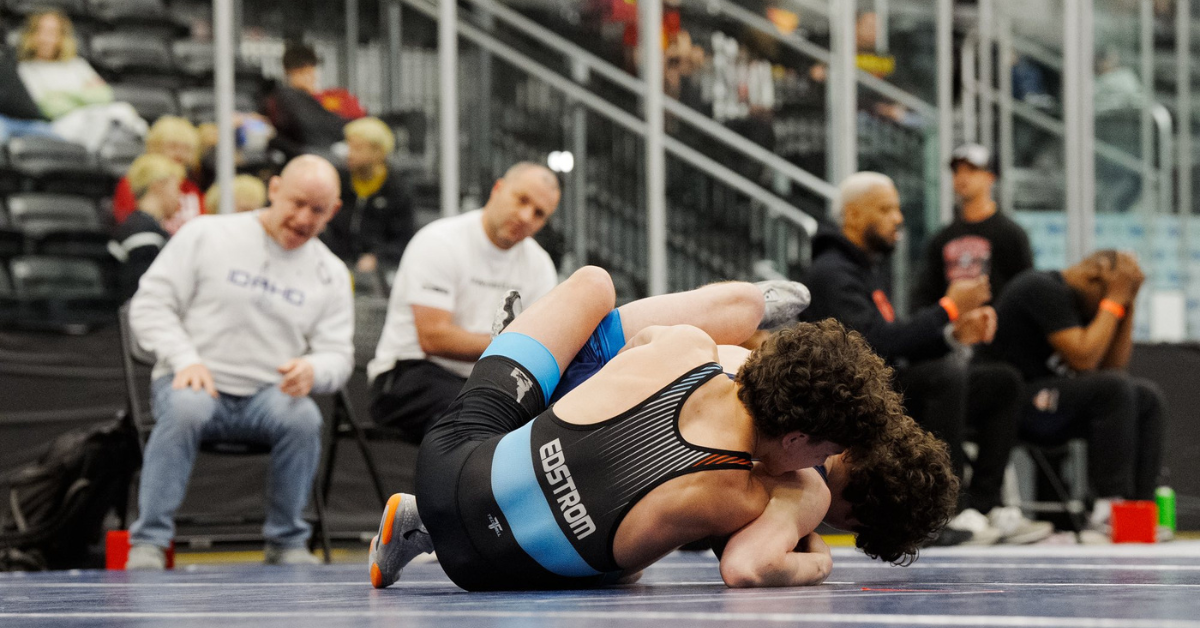
Photo Credit: Idaho USA Wrestling
For years, Idaho wrestling has been building something—slowly, steadily, and often outside the national spotlight. But every winter, when the mats roll out at the US Folkstyle National Championships in Iowa, the Gem State brings its measuring stick. And in 2026, that rising tide rolled a little higher.
Team Idaho didn’t arrive with the noise of the sport’s traditional powerhouses. There were no massive rosters or national hype trains. What Idaho brought instead was something far more familiar to those who follow wrestling in the state: quiet confidence, battle-tested toughness, and a wave of athletes ready to prove they belong on the national stage.
By the end of the tournament, the proof was standing on the podium.
Leading the charge were two champions who embodied the current surge of Idaho wrestling. Sean Hall of Canyon Ridge and Jake Mescher of Bishop Kelly didn’t just win titles—they controlled their brackets with the kind of composure that signals more than a single tournament run. Hall, already a four-time Idaho state placer, wrestled with the poise of a veteran, while Mescher, a two-time state champion, showed the kind of technical command that continues to elevate Idaho’s reputation beyond its borders. When the finals ended, both stood atop the podium, Idaho flags draped across their shoulders.
Their victories weren’t isolated moments—they were the latest chapter in a story Idaho wrestling has been writing over the past several seasons.
At the junior level, Idaho’s depth showed itself again. Tristan Mendenhall of Post Falls, Burke Blue of Centennial, and Brand’n Edstrom of Madison battled their way into the top five, navigating deep national brackets that demand both skill and resilience. Right behind them, wrestlers like Greysen Packer, Malachi Burnham, and Vincent Contreras continued to prove that Idaho’s strength isn’t built on a handful of stars, but on a pipeline of athletes emerging from programs across the state.
That pipeline has been building momentum—and the results are now stacking up consistently year after year in Iowa. Chris Owens, the Idaho national coach behind the transformative “Blue Print for Action” that has propelled Idaho onto the national stage, put it this way: “Team Idaho had a great weekend at folkstyle nationals bringing home a record 30 All Americans, 6 finalists, 3 champs and a lot of quality mat time logged verse high level national competition – Our top performers excelled in the top position and in finishing leg attacks – it’s great to see since this has been the game plan for a couple of years now and it’s great to see all the training, dedication and sacrifice these wrestlers put into the sport fall into place for them- I sure love seeing Idaho wrestlers at the top of the podium. hopefully this plants a seed of desire in many young Idaho wrestlers that they can someday achieve the pinnacle of being a national champion at the high school level!”
One of the most striking signs of Idaho’s evolution came on the girls side of the bracket, where the state’s rapidly expanding girls wrestling programs are beginning to pay national dividends. Tayler Brown of Thunder Ridge stormed to a national championship, while teammate Shauna Anderson battled her way to the finals for a runner-up finish. Together, they represented a program—and a movement—that has quickly become one of the most exciting developments in Idaho wrestling.
Behind them, All-Americans like Keanna Conrad and Maritza Garcia added to the momentum, reinforcing the reality that Idaho’s girls wrestling pipeline is not only growing—it’s becoming nationally relevant.
If the past few years have taught anything about Idaho wrestling at the Folkstyle Nationals, it’s this: the state keeps coming back stronger.
Each season, new names emerge. New programs rise. And new wrestlers step onto the national stage without hesitation. Idaho may not yet carry the massive numbers of California or the century-old wrestling traditions of Pennsylvania, but what it does bring is unmistakable—grit, discipline, and a culture that refuses to back down.
The 2026 US Folkstyle National Championships didn’t just produce champions and All-Americans. They offered another snapshot of a programmatic shift happening across the Gem State.
From small-town wrestling rooms to powerhouse high school programs, Idaho is building something real.
And if the results in Iowa are any indication, the rest of the country is starting to notice.
One podium at a time.
WE’RE ONE IDAHO.
TEAM IDAHO 2026 ALL-AMERICANS [16U | Junior]
JUNIOR ALL-AMERICANS
100 – Malachi Burnham (Century, 10, 5A), 6th Place
106 – Tristan Mendenhall (Post Falls, 10, 6A), 4th Place (5th, 1st State)
106 – Burke Blue (Centennial, 10, 6A), 5th Place (4th, 2nd State)
120 – Brand’n Edstrom (Madison, 11, 6A), 4th Place (2nd, 2nd, 1st State)
120 – Greysen Packer (South Fremont, 10, 4A), 5th Place (1st, 1st State)
126 – Vincent Contreras (Nampa, 12, 5A), 7th Place (2nd, 2nd, 1st, 1st State)
144 – Sean Hall (Canyon Ridge, 12, 6A), NATIONAL CHAMPION (4th, 3rd, 1st, 1st State)
150 – Jake Mescher (Bishop Kelly, 11, 5A), NATIONAL CHAMPION (2nd, 1st, 1st State)
157 – Drake Morrison (Malad, 11, 3A), 8th Place (3rd, 1st, 1st State)
175 – Ryan Lewis (Middleton, 12, 5A), 8th Place (3rd, 1st, 1st State)
215 – McGregor Miller (Madison, 11, 6A), 6th Place (2nd, 1st, 1st State)
16U ALL-AMERICANS
88 – Max Alley (Madison, 10, 6A), 7th Place
94 – Xander Edstrom (East Idaho Elite), 3rd Place
126 – Scout Scott (Bonneville, 9, 5A), 2nd Place (State Champion)
126 – Owen Williams (Bonneville), 8th Place
144 – Lincoln Steele (Vale, 9), 2nd Place
285 – Sidi Kante (Madison, 10, 6A), 3rd Place (State Champion)
JUNIOR ALL-AMERICANS (GIRLS)
100 – Tayler Brown (Thunder Ridge, 12, 6A), NATIONAL CHAMPION (6th, 1st, 2nd State)
110 – Amea Whittington (Caldwell, 11, 6A), 4th Place
110 – Taylor Drake (Kuna, 11, 6A), 6th Place (6th, 1st, 3rd State)
115 – Kinzie Williams (American Falls. 11, 4A), 4th Place (3rd, 2nd, 1st State)
135 – Keanna Conrad (Blackfoot, 11, 5A), 3rd Place (1st, 1st, 1st State)
155 – Ciel Sattler (Deary, 11, 1A ), 8th Place (2nd State)
190 – Shauna Anderson (Thunder Ridge, 12, 6A), 2nd Place (2nd, 1st, 1st, 1st State)
16U ALL-AMERICANS (GIRLS)
100 – Maritza Medina (Caldwell, 10, 6A), 3rd Place (4th, 1st State)
110 – Mya Bolander (Idaho Falls HS), 7th Place (State Champion)
120 – Akeelah Gonzalez (Snake River, 9, 4A), 6th Place (State Qualifier)
135 – Jadyn Jackson (Kuna, 9, 6A), 4th Place (4th Place)
140 – Annabelle Harmon (Caldwell, 9, 6A), 4th Place (State Qualifier)
207 – Maritza Garcia (Caldwell, 10, 6A), 2nd Place (State Qualifier)
Division Analysis – Idaho High School Classifications at Folkstyle Nationals
6A Division: Depth and Elite Contenders
The 6A classification clearly produced the largest volume of All-Americans and the broadest competitive depth. Programs from large schools such as Madison, Thunder Ridge, Centennial, Post Falls, and Canyon Ridge consistently placed wrestlers deep into the national brackets.
Key Results
* Sean Hall (Canyon Ridge) – Junior National Champion
* Tayler Brown (Thunder Ridge) – Girls Junior National Champion
* Shauna Anderson (Thunder Ridge) – Girls Junior Runner-Up
* Tristan Mendenhall (Post Falls) – 4th
* Brand’n Edstrom (Madison) – 4th
* McGregor Miller (Madison) – 6th
* Max Alley (Madison) – 7th (16U)
* Sidi Kante (Madison) – 3rd (16U)
* Multiple girls placements from Caldwell, Kuna, Thunder Ridge
Analysis
6A demonstrated three major strengths:
1. Depth Across Weight Classes
No other classification placed as many wrestlers across both age divisions and genders. The results span lightweights through heavyweights, indicating balanced program development.
2. Established Programs Driving Results
Madison and Thunder Ridge appear repeatedly. Madison alone produced multiple All-Americans, reinforcing its status as one of the state’s most consistent developmental hubs.
3. Girls Wrestling Momentum
6A schools dominate the girls results, particularly Thunder Ridge and Caldwell, suggesting that larger programs with more resources are accelerating growth in the girls pipeline.
Overall Assessment
6A is Idaho’s most complete competitive division nationally—producing both champions and a high volume of All-Americans. Its advantage lies in depth, infrastructure, and year-round club support.
5A Division: High-End Championship Talent
While not as deep as 6A, the 5A classification produced arguably the most impressive championship output relative to its size.
Key Results
* Jake Mescher (Bishop Kelly) – Junior National Champion
* Vincent Contreras (Nampa) – 7th
* Ryan Lewis (Middleton) – 8th
* Malachi Burnham (Century) – 6th
* Scout Scott (Bonneville) – 2nd (16U)
* Keanna Conrad (Blackfoot) – 3rd (Girls Junior)
Analysis
1. Elite Title Contenders
Jake Mescher’s national championship highlights the top-end quality emerging from 5A. Programs like Bishop Kelly and Blackfoot have a history of developing nationally competitive athletes.
2. Strong Upperclassmen Leadership
Several placements came from juniors and seniors, suggesting that 5A athletes often peak later in their development but arrive nationally ready.
3. Strong Eastern Idaho Influence
Blackfoot and Bonneville continue the region’s tradition of producing high-level wrestlers, reflecting the strong club infrastructure in eastern Idaho.
Overall Assessment
5A punches above its weight, producing fewer qualifiers but high-impact performances, including national champions and finalists.
4A Division: Emerging National Presence
The 4A classification produced fewer All-Americans, but those who did place showed strong upward potential.
Key Results
* Kinzie Williams (American Falls) – Girls Junior 4th
* Akeelah Gonzalez (Snake River) – Girls 16U 6th
Analysis
1. Smaller Numbers, High Potential
4A programs naturally have smaller athlete pools, which reduces national representation.
2. Girls Programs Gaining Momentum
The majority of the division’s national placements came from girls wrestling, indicating rapid growth at smaller schools.
3. Development Stage
Many of these athletes are underclassmen, suggesting the possibility of stronger results in future national events.
Overall Assessment
4A currently sits in a developmental phase nationally, but the emerging success of its girls athletes suggests future upward movement.
3A Division: Small-School Breakthroughs
The 3A classification had limited representation but still produced meaningful national results.
Key Result
* Drake Morrison (Malad) – Junior 8th Place
Analysis
1. Individual Excellence Over Depth
Small schools often rely on standout individuals rather than broad team depth.
2. Malad’s Continued Tradition
Malad has historically been a strong wrestling community, and Morrison’s placement continues that legacy.
3. Resource Gap
Compared to larger schools, 3A programs often have fewer training partners and limited access to elite club systems, making national placements particularly impressive.
Overall Assessment
3A success reflects individual determination and strong community wrestling culture, even without the infrastructure advantages of larger classifications.
Cross-Division Trends
1. Champions Distributed Across Classifications
National champions came from:
* 6A – Sean Hall
* 5A – Jake Mescher
* Girls 6A – Tayler Brown
This shows elite talent exists across Idaho’s classification spectrum, not just in the largest schools.
2. Eastern Idaho Pipeline
Programs like Madison, Bonneville, Blackfoot, and American Falls appear frequently in the results. This region continues to function as Idaho’s most consistent wrestling pipeline.
3. Youth Development Paying Off
Several freshmen and sophomores placed nationally, particularly in the 16U division, indicating Idaho’s club system and youth programs are strengthening the pipeline.
Overall Division Rankings Based on Results
Considering volume, placements, and championships:
1. 6A – Most depth and multiple champions
2. 5A – Highest impact relative to size
3. 4A – Emerging talent, especially in girls wrestling
4. 3A – Limited numbers but meaningful individual success
Bottom Line
The 2026 Folkstyle Nationals results reinforce a key trend in Idaho wrestling:
* 6A provides depth and infrastructure
* 5A produces elite championship contenders
* 4A and 3A continue to develop talent capable of breaking through nationally
Together, they reflect a healthy statewide pipeline where national-level wrestlers are emerging from every classification.
|